
SunEye Bowling: China Bowling Equipment Manufacturer Profile
SunEye Bowling is the trading brand of YUANXIANG BOWLING (GUANGZHOU) CO., LTD., a bowling equipment manufacturer established in 2021 and based in Guangzhou, China. The company produces standard bowling, duckpin bowling and mini bowling systems, together with string pinsetters, bowling lanes, ball return systems, scoring systems, bowling pins and bowling balls. Around 80% of its output is exported, and the company states that its equipment is installed in more than 3,000 venues worldwide.
That short paragraph is the answer most buyers are looking for when they begin researching bowling equipment suppliers. The harder question is what sits behind it: who actually builds the machines, what the specification sheets really say, how certifications are held, and whether the supplier can carry a venue project from an empty floor to an opening night.
This profile examines SunEye Bowling on those terms. It covers company background, core product lines and technical specifications, manufacturing and R&D capability, quality and compliance, global supply reach, application fit, and the procurement questions a buyer should resolve before issuing a purchase order. Where evidence is company-reported rather than independently verified, that is stated plainly.
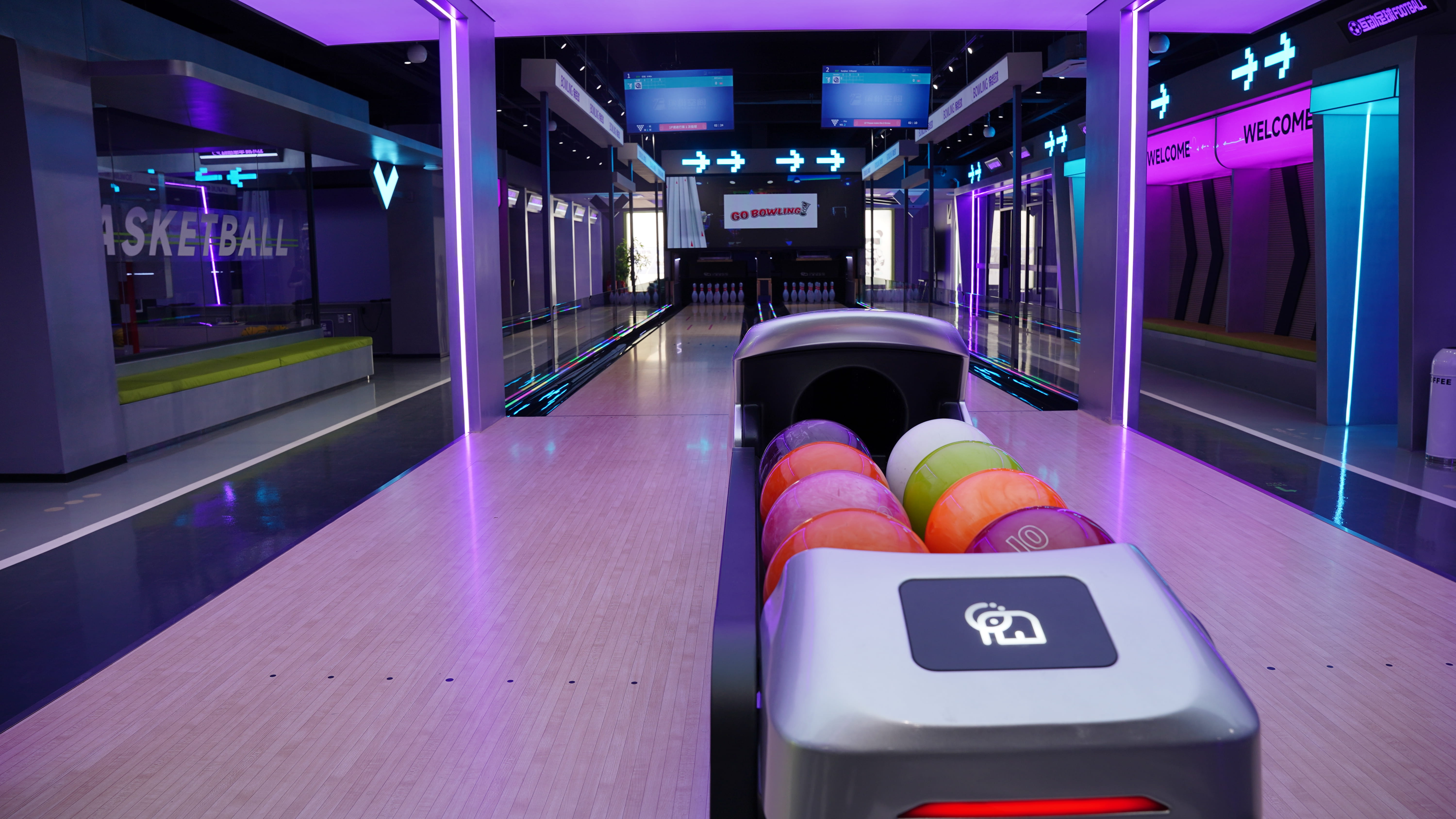 SunEye standard bowling equipment: a complete string pinsetter bowling system supplied for commercial bowling lanes.
Problem Definition: Why Bowling Equipment Suppliers Are Hard to Compare
Bowling equipment sits in an unusual procurement category. The installed base is relatively stable, purchase cycles are long, and most buyers will only ever run one or two equipment projects in their career. As a result, supplier information asymmetry is high.
Three specific problems recur in this category:
- Manufacturer versus trader. Many companies list bowling equipment for sale, but fewer operate a production facility. A buyer who treats a trading intermediary as a factory will misjudge lead time, customization limits and post-sale support.
- Format ambiguity. Standard bowling, duckpin bowling and mini bowling are different systems with different lane lengths, pin sizes, ball weights and venue economics. Generic quotes that do not specify format cannot be compared.
- Compliance opacity. Competition-level play, insurance requirements and venue licensing in some markets depend on whether lanes and pinsetters meet recognised standards. Not every listing states which approvals apply or at what scope.
The practical answer is a structured supplier review: confirm the legal entity and production location, separate the product family into named formats, extract the measurable specifications, and check which certifications attach to which component. The remainder of this profile applies that framework to SunEye Bowling.
Industry Background: A Moderately Growing Market in a Format Shift
The global bowling equipment category is expanding at a measured pace. HTF Market Intelligence estimates the market at USD 1.05 billion in 2025, with a forecast of USD 1.78 billion by 2033 and a compound annual growth rate of 6.0% across 2026–2033. That figure covers equipment sold into the category, including balls, pins, lanes and scoring systems.
Demand structure differs sharply by market. Industry profiles place the United States at approximately 2,800 bowling centres, classified under NAICS code 713950 — a mature operator base where equipment purchases are driven mainly by replacement and refurbishment rather than new construction. The Federal Reserve Bank of St. Louis also publishes a long-running revenue series for bowling centres (series ID REVEF71395ALLEST) covering 1998–2022, built on US Census Bureau data.
The most consequential technical shift in the category is the move from free-fall pinsetters to string pinsetters. The United States Bowling Congress addresses string pinsetters under Chapter 95 of its equipment specification. USBC-approved string pin machines use longer strings — 54 inches — to simulate free-fall action while reducing tangles.
For buyers, this shift changes the economics of a lane. A string pinsetter carries fewer moving parts than a traditional free-fall machine, which lowers mechanical complexity and long-term maintenance load. It also changes what a buyer must verify: not only that a machine works, but that it meets the standard that applies to the venue's intended level of play.
A note on market data: published figures for the broader "bowling market" vary widely between research publishers because some count operator revenue while others count equipment manufacturing only. These numbers should not be averaged or used interchangeably. Treat market sizing as a directional input, not a budget line.
Company Background: SunEye Bowling and Its Parent Entity
SunEye Bowling operates under the legal entity YUANXIANG BOWLING (GUANGZHOU) CO., LTD., established in 2021. The company describes itself as a comprehensive bowling equipment supplier covering research and development, manufacturing, sales, installation and after-sales service, with an integrated model extending from product development through project delivery and operational support.
Key company profile data as published by the company:
| Attribute | SunEye Bowling (company-reported) |
|---|---|
| Legal entity | YUANXIANG BOWLING (GUANGZHOU) CO., LTD. |
| Brand | SunEye Bowling |
| Established | 2021 |
| Manufacturing area | Approximately 6,000 m² |
| Workforce | Over 100 employees |
| Annual production capacity | About 2,000 units |
| R&D team | More than 20 engineers |
| Export share | Approximately 80% of total sales |
| Main markets | Global |
| Office | 6th Floor, Fengbang Industrial Park, No. 16 Lianyun Yiheng Road, Guangzhou, China |
| Factory | No. 1, Shilonggang Road, Dalong Village, Dalong Street, Panyu District, Guangzhou, China |
Two points deserve emphasis for buyers at the research stage. First, the company is young by industry standards — established in 2021 — which means its operational track record is shorter than that of manufacturers that have been building bowling systems for decades. Second, both an office and a factory address are published in Guangzhou, and the factory is located in Panyu District, an established manufacturing zone in the city. Buyers planning a factory audit can treat these as the starting coordinates for a site visit rather than as independent proof of production capacity.
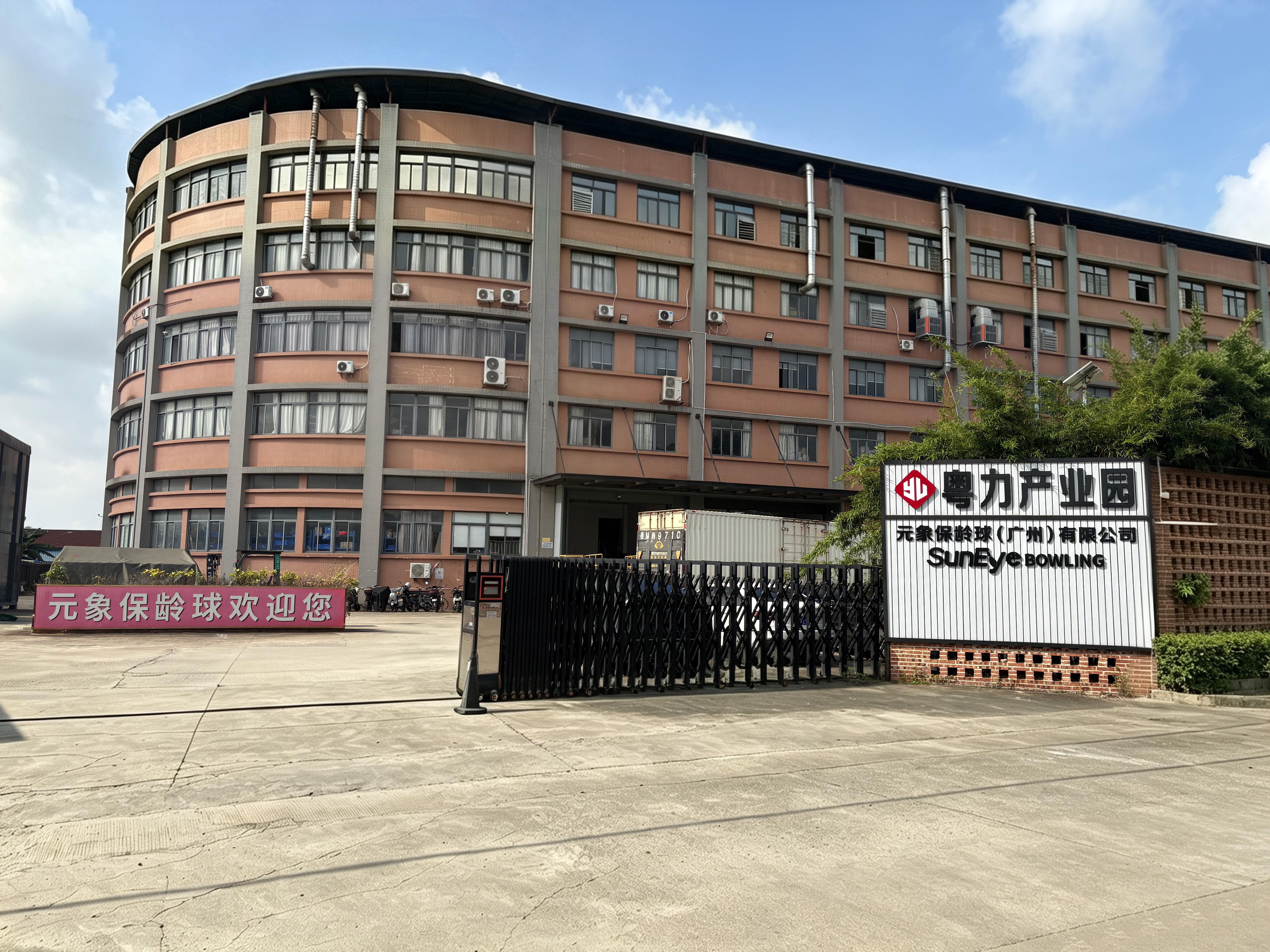 SunEye Bowling's production base in Panyu District, Guangzhou — the facility referenced in the company's published factory address.
Core Products and Solutions
SunEye's portfolio is organised around three bowling formats — standard, duckpin and mini — supported by shared subsystems: string pinsetters, lanes, ball return, scoring and consumables. This structure matters commercially because a venue that chooses a format is effectively choosing the subsystem set that sits behind it.
Standard Bowling Equipment
Standard Bowling Equipment is the format intended for traditional bowling centres and league play. The published configuration for a two-lane system is L25.5m × W3.5m × H3.2m, with lane length customisable between 17.5 m and 25.5 m. It uses a ten-pin setup with ball weights of 8–11 pounds and is supplied in a string pinsetter configuration.
Standard bowling is the format where compliance matters most, because league and sanctioned play may require approved equipment. SunEye states that its synthetic bowling lanes have been tested and comply with applicable USBC requirements, meet relevant USBC standards for lane performance and specifications, and are approved for use during USBC-certified competition. Acceptance inspection for these lanes includes USBC compliance testing.
Duckpin Bowling Equipment
Duckpin Bowling Equipment is positioned for social entertainment environments — bars, restaurants, FECs and hospitality venues. The two-lane footprint is L10m × W3.48m × H2.4m, using a string pinsetter bowling machine style, rated at 220V with 2000W per lane. Ball weight runs 3.3–3.75 pounds, and the pin type is ten-pin duckpin.
The duckpin configuration uses a centralised scoring approach with a large HD display integrated into a compact equipment zone, which can also serve as a visual backdrop behind the lanes. A master control console lets operators manage lane operation, scoring and venue operations from a single system.
Mini Bowling Equipment
Mini Bowling Equipment targets family entertainment centres, children's venues and compact sites. The two-lane footprint is L13m × W2.83m × H2.5m, with lane length customisable between 13.6 m and 19 m. Ball weight is 3.3–3.75 pounds and the pin type is ten-pin mini bowling.
Two features distinguish the mini configuration. The lane itself is a heavy-duty synthetic design built from multi-layer high-density pressed panels with a scratch-resistant surface coating and sealed edges, rated to withstand more than 100,000 ball impacts with a service life of up to 10 years. The masking wall uses a backlit soft-film lightbox that can be customised with graphics, colours, patterns and brand logos — a practical detail for venues where the bowling installation doubles as an advertising surface.
String Pinsetter Machine
The String Pinsetter Machine is the shared reset mechanism across formats. Published specifications: 2000W, 220V, metal construction, ten pins, and a pin reset speed of 8 seconds per cycle. Control is servo motor based with smart calibration, and the system is configured for continuous 24/7 operation.
The design intent is mechanical simplicity. The stated pin placement accuracy carries an offset of no more than 2 mm, and the simplified mechanical structure reduces moving parts relative to a traditional free-fall machine, which in turn reduces downtime exposure and long-term maintenance requirements.
Bowling Ball Return System
The Bowling Ball Return System is rated at 2000W and 220V with a return speed of 12 seconds and a return track length of 18–26 m, customisable to the lane configuration. It uses flexible drive components and cushion guides to keep ball transport smooth, stable and low-noise, and includes a self-diagnostic function that automatically detects and clears minor jams.
The company reports a jam failure rate of 0.002% for this system, against a stated industry range of 0.02%–0.05%. Buyers should treat that comparison as a company-reported figure and, if it matters to the business case, ask for the underlying test conditions before relying on it in a maintenance model.
Scoring System and HD Score Display
The scoring system combines camera-based image recognition with infrared sensors to detect pin status. The display resolution is 1280 × 720, and the system is specified to recognise difficult pin conditions including slightly tilted and partially knocked-over pins.
Reported performance is up to 99.98% recognition accuracy with a 0.02% misread rate. Software is maintained through free lifetime OTA updates. Game modes include featured tournaments and a PK system, with support for local or remote cross-store online PK, participation in officially organised national challenge tournaments, and the ability for venue stores and merchants to publish in-store challenge events.
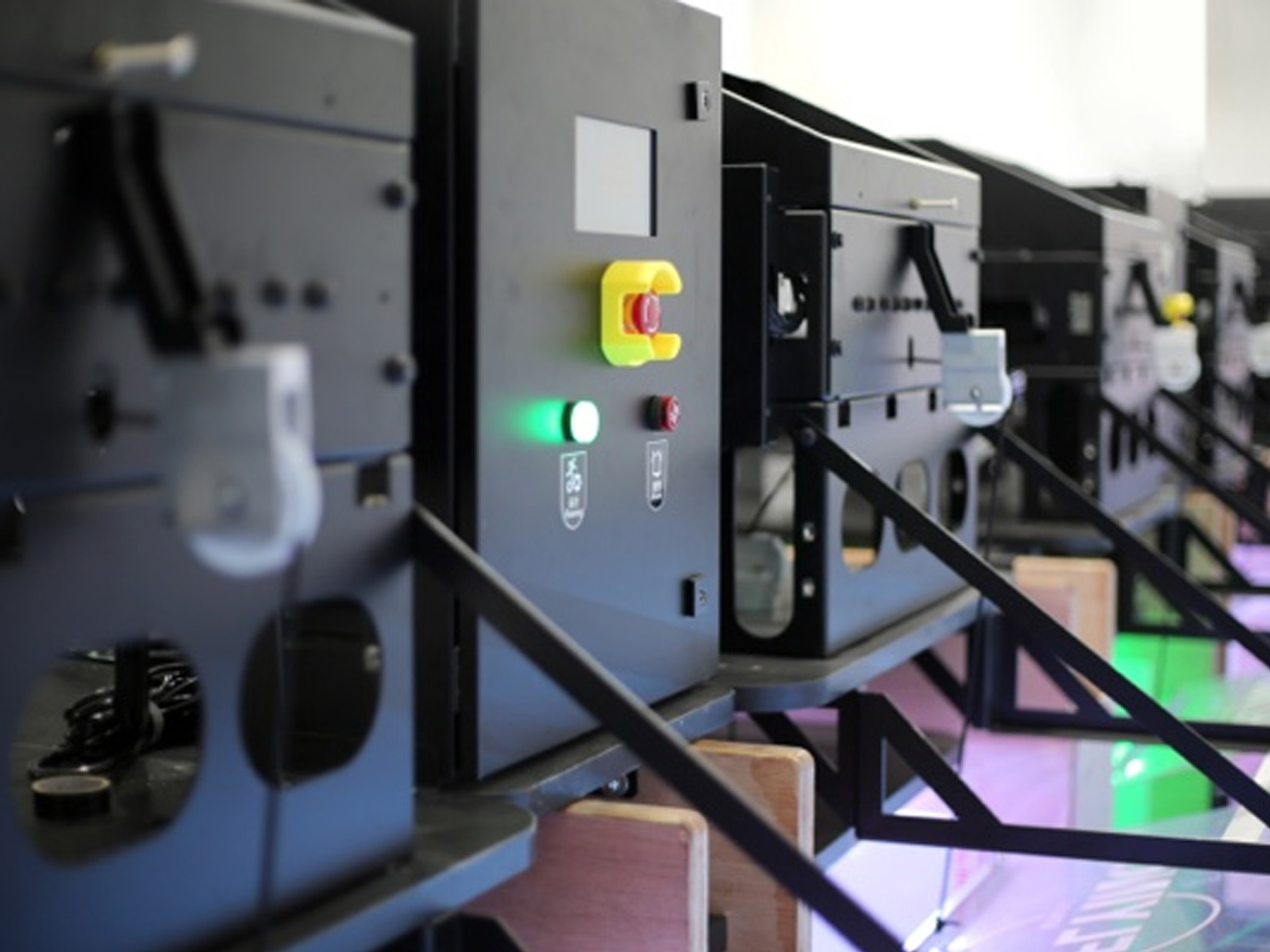 The SunEye string pinsetter machine, specified for an 8-second pin reset cycle and continuous 24/7 operation.
Bowling Pins and Consumables
SunEye manufactures pins in three formats, all built from maple wood and plastic and all carrying USBC certification alongside CE, LVD and MD marks. Packing is carton box with a 40-day delivery time.
| Pin | Height | Weight | Compatible formats |
|---|---|---|---|
| Standard Bowling Pin | 380 mm | 1,618 g | Standard bowling |
| Duckpin Bowling Pin | 230 mm | 787 g | Duckpin bowling |
| Mini Bowling Pin | 265 mm | 735 g | Mini bowling; compatible with duckpin systems |
All three pin types can be customised with pin colours, logos, graphics and patterns for brand and venue identity. The company also lists bowling balls within its product range.
Customisation and OEM Services
Customisation is built into the product architecture rather than offered as an exception. Documented customisation capability includes pin colour and graphics, logo application on pins, mini bowling masking wall graphics and lightbox branding, and lane length adjustment — standard lanes from 17.5 m to 25.5 m, mini lanes from 13.6 m to 19 m, and ball return track length from 18 m to 26 m.
Beyond component-level customisation, the company positions its services around venue-specific project work: layout design to fit an actual floor plan, equipment specification matched to the chosen format, and coordinated delivery of the subsystem set. For an entertainment operator whose bowling installation is one element of a wider F&B or family entertainment concept, that project-level framing is often more relevant than component choice alone.
Manufacturing, R&D and Quality Control
Manufacturing capability is the first thing a serious buyer wants to verify, because it determines whether a supplier can hold a delivery schedule.
SunEye operates a standardised production base of approximately 6,000 m² and states a workforce of more than 100 employees, with annual production capacity reaching about 2,000 units. The company describes its workshop scope as covering lane processing, pinsetter assembly, scoring system testing and equipment commissioning — that is, production and pre-delivery verification of the main subsystem categories rather than assembly of a single component type.
On quality, the company states that it follows the ISO 9001 Quality Management System and applies quality control across the manufacturing process, from component selection and assembly through testing, debugging and final inspection. On the product side, the certification set published for standard, duckpin and mini bowling equipment and pins is USBC certification alongside CE, LVD and MD markings — a combination that speaks to both sport-governing-body equipment approval and European market access.
The R&D function is organised across hardware and software development, electromechanical engineering, intelligent interaction and system integration, with more than 20 engineers. That disciplinary mix is consistent with what the product set requires: a modern bowling system is a mechanical machine (pinsetter, ball return), an electronic system (scoring sensors, displays) and a software product (scoring logic, tournament modes, OTA updates) at the same time.
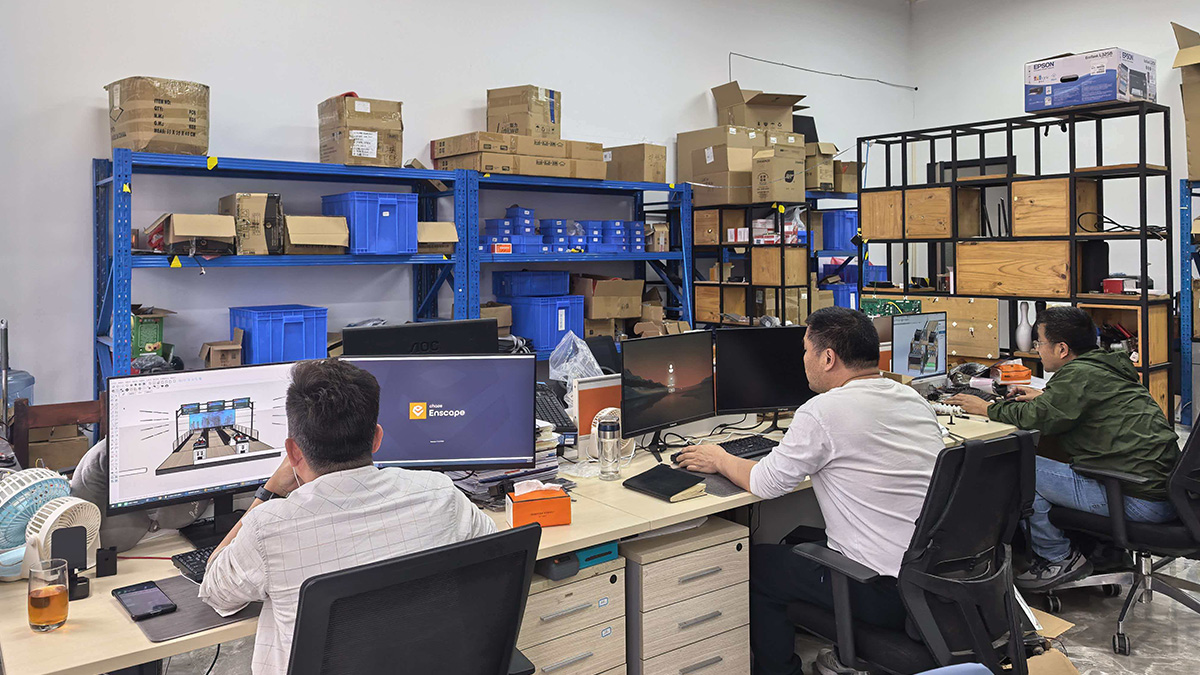 SunEye's R&D team spans hardware and software development, electromechanical engineering, intelligent interaction and system integration.
Step-by-Step Breakdown: How a SunEye Bowling Project Runs
For buyers in the research stage, the value of a supplier profile is understanding the delivery sequence, because that is where projects usually go wrong. SunEye describes a turnkey process that runs through the following stages.
- Brief and site input. The buyer provides site drawings or CAD drawings. The process starts from the actual floor plan rather than a catalogue configuration.
- Venue planning and layout design. The team plans according to the site, fitting lane count and format to the available footprint. This is where the format decision is effectively locked: standard bowling needs roughly 26 m of length, mini bowling roughly 13 m, and duckpin roughly 10 m.
- CAD layout and 3D rendering. Layout is documented and visualised before production is committed, giving the operator something concrete to review against construction and interior fit-out plans.
- Equipment customisation and manufacturing. Lane lengths, graphics, branding and configuration details are fixed, then produced at the Guangzhou facility.
- Logistics coordination and global shipping. Equipment is packed — wooden box for standard, duckpin and mini systems, carton box for pins — and shipped.
- Installation and commissioning. Installation guidance and equipment commissioning are part of the service scope, with the system tested in place.
- Staff training. Operators are trained on the installed system, including lane operation and scoring management.
- After-sales support. Ongoing operational support, with software maintained through free lifetime OTA updates on the scoring system.
Two practical notes for procurement. First, the sequence above is the reason to involve the equipment supplier early — lane length and format constraints feed directly into lease negotiation and construction drawings. Second, because turnkey means different things to different suppliers, a request for quotation should separate equipment supply, civil works, installation, commissioning, training, warranty and operational support into distinct line items rather than accepting a single bundled figure.
Use Cases: Where SunEye Systems Fit
The company publishes three application environments, each matched to a different subsystem configuration.
Commercial Bowling Centres
For bowling centres, hotels and resorts, entertainment complexes and shopping and leisure centres, the matched configuration is standard bowling equipment with a string pinsetter system, ball return system and scoring system, running in continuous 24/7 operation. This is the segment where league play and sanctioned competition raise the importance of USBC-compliant lanes and certified pins.
Family Entertainment Centres and Kids' Venues
For FECs, kids' playgrounds, shopping malls, arcades and family-oriented hospitality venues, mini bowling equipment is the appropriate format. Shorter lanes, lighter 3.3–3.75 pound balls and the 13 m footprint make mini bowling viable in spaces that cannot accommodate a standard lane. The customisable soft-film masking wall also lets a venue carry its own brand identity into the bowling zone.
Social Entertainment, Bars and Restaurants
For bars, restaurants, breweries, social clubs and mixed-use hospitality venues, duckpin bowling equipment is the matched format. The 10 m lane length is the shortest of the three, and the centralised scoring and control layout keeps the equipment zone compact — a design that suits venues where bowling is one activity within a broader food and beverage offer.
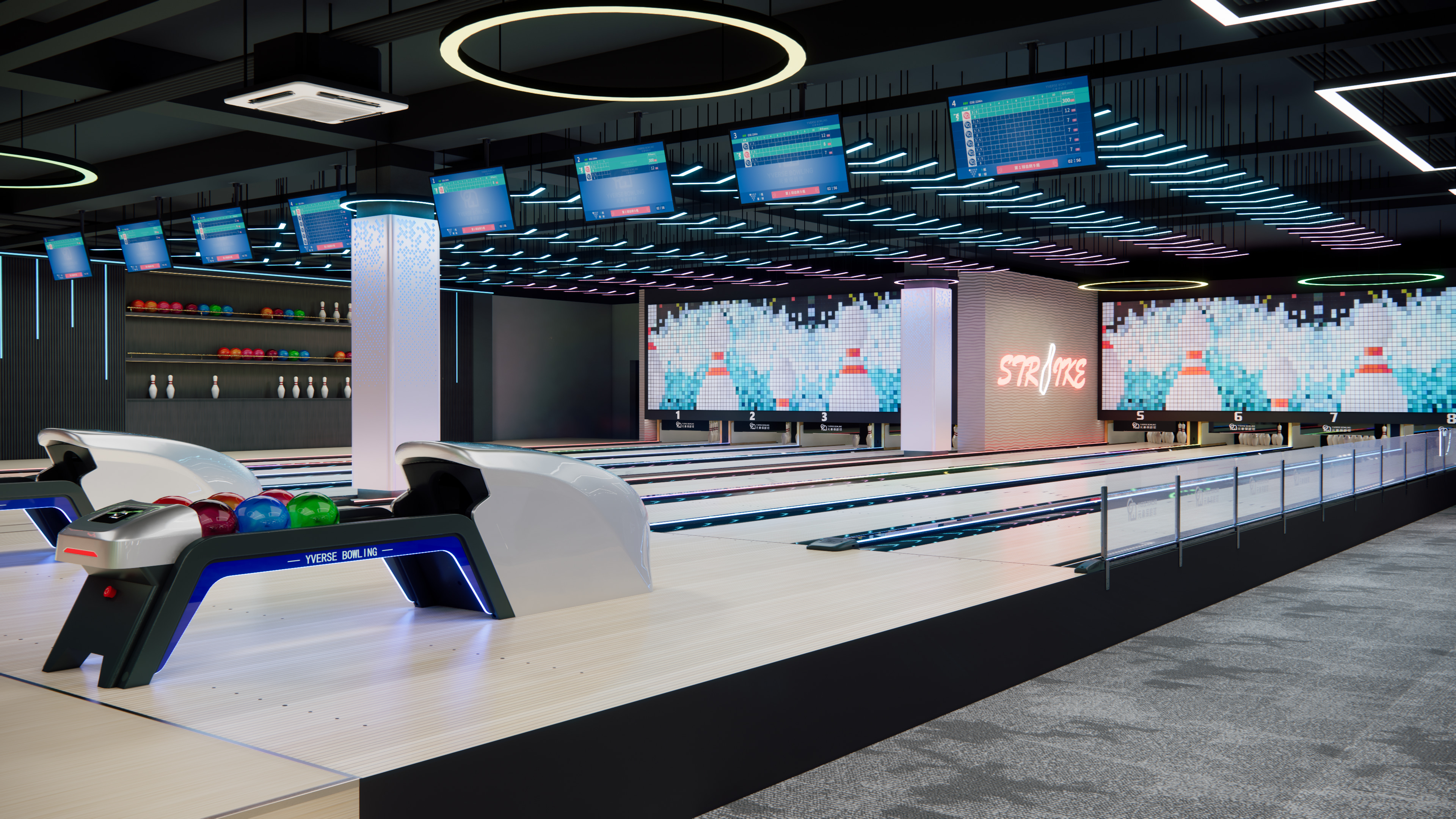 A commercial bowling centre configuration using standard bowling equipment, string pinsetters, ball return and scoring systems.
Comparison Table: Standard, Duckpin and Mini Bowling Equipment
The table below compares the three SunEye bowling formats on published specification data. It is intended as a format-selection aid for buyers, not as a competitive ranking.
| Parameter | Standard Bowling Equipment | Duckpin Bowling Equipment | Mini Bowling Equipment |
|---|---|---|---|
| System type | Standard Bowling System | Duckpin Bowling System | Mini Bowling System |
| Brand | Suneye | Suneye | Suneye |
| Footprint (2 lanes) | L25.5m × W3.5m × H3.2m | L10m × W3.48m × H2.4m | L13m × W2.83m × H2.5m |
| Customisable lane length | 17.5–25.5 m | Not stated | 13.6–19 m |
| Pinsetter style | String pinsetter bowling machine | String pinsetter bowling machine | String pinsetter bowling machine |
| Pin type | Ten-pin bowling | Ten-pin duckpin bowling | Ten-pin mini bowling |
| Ball weight | 8–11 lb | 3.3–3.75 lb | 3.3–3.75 lb |
| Rated voltage | Not separately stated | 220V | Not separately stated |
| Rated power | Not separately stated | 2000W per lane | Not separately stated |
| Certification | USBC-Certified, CE, LVD, MD | USBC-Certified, CE, LVD, MD | USBC-Certified, CE, LVD, MD |
| Packing | Wooden box | Wooden box | Wooden box |
| Typical venue | Traditional bowling centres, league play | Bars, restaurants, FECs, social entertainment venues | Children's centres, FECs, compact spaces |
Common subsystems across all three formats include the string pinsetter machine (2000W, 220V, 8-second pin reset), the ball return system (2000W, 220V, 12-second return, 18–26 m track) and the scoring system with HD display, AI vision and infrared pin detection.
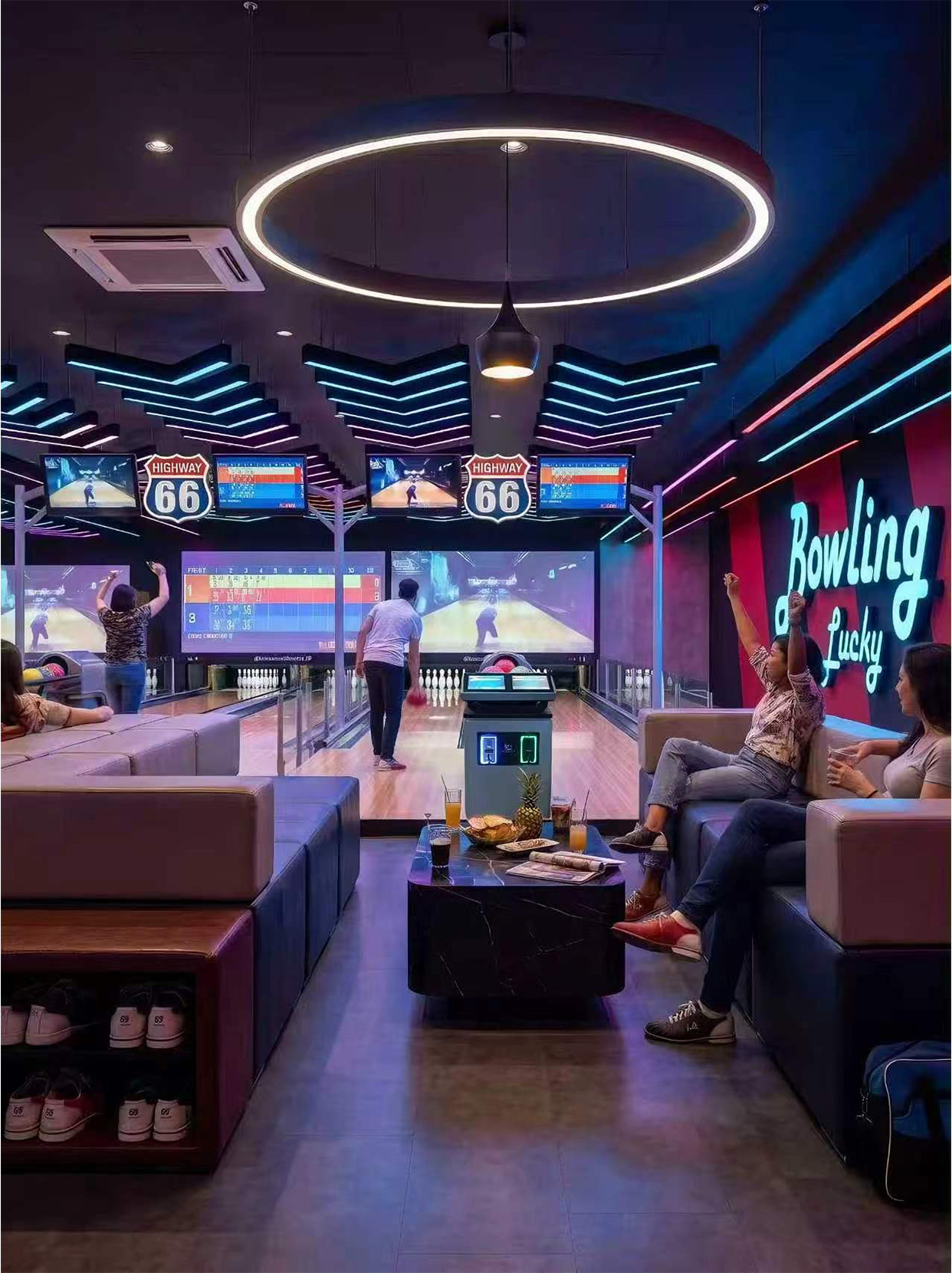 Mini bowling equipment in a family entertainment centre — a 13 m format suited to compact venues and younger players.
Market Recognition and Industry Positioning
Publicly available information about SunEye's market position is largely company-reported, and it is worth separating what can be stated from what remains to be verified.
Customer reach. The company states that its equipment serves more than 3,000 customers across 50-plus countries. This is a company-reported footprint and is not backed by an independent audit in the public record.
Export orientation. Approximately 80% of products are exported, accounting for 80% of total sales. An export share at that level indicates the company's operating model is built around international project delivery — documentation, packing, freight coordination and remote installation support — rather than domestic volume alone.
Compliance positioning. USBC certification on pins and USBC compliance testing on synthetic lanes places the product set within the framework that governs sanctioned bowling in the United States. It is a compliance position, not a market-share claim.
Peer context. The bowling equipment supply landscape includes both long-established global manufacturers and a larger group of Chinese manufacturers offering integrated product portfolios and turnkey delivery. Flying Bowling, for example, publicly lists string pinsetters, lanes, scoring systems, ball return systems, masking units, balls, pins, accessories and turnkey solutions — a portfolio breadth similar in structure to SunEye's. The competitive question for a buyer is therefore not who lists the widest catalogue, but who can evidence the specific capability the project needs.
Selling Points and Procurement Value
Stripping out promotional language, the procurement case for SunEye Bowling rests on five verifiable characteristics.
1. Format coverage from a single supplier. Standard, duckpin and mini bowling systems, plus the pinsetter, lane, ball return, scoring and consumable layers behind them. For an operator building a mixed-format venue or comparing formats during feasibility, one supplier covering all three reduces coordination overhead and simplifies spares planning.
2. Quantified subsystem specifications. Many equipment listings describe features without numbers. SunEye publishes measurable values: 8-second pin reset, 12-second ball return, 18–26 m ball return track, 2 mm pin placement offset, 1280 × 720 display resolution, 2000W and 220V power ratings, and specific lane footprints. These are the values a buyer can put into a layout drawing and a power schedule.
3. Lane durability specification. The synthetic lane is rated for 100,000-plus ball impacts with a service life of up to 10 years and is built with multi-layer high-density pressed panels and sealed edges to resist peeling, cracking and deformation. For a commercial venue running 24/7, lane surface life is a direct driver of refurbishment timing and total cost of ownership.
4. Documented customisation depth. Lane length variation, pin colour and graphics, logo application and branded masking walls. Customisation is priced and specified at component level rather than offered as an undefined service.
5. Software maintained at no recurring cost. Lifetime free OTA updates on the scoring system, combined with tournament and cross-store PK game modes, removes a recurring software licence line from the operating budget and gives the venue a competitive-play feature set.
Against these, buyers should weigh the company's short operating history and the fact that several performance claims — including the 99.98% scoring recognition accuracy and the 0.002% ball return jam failure rate — are company-reported and should be validated against reference installations or test documentation before being modelled into an operating forecast.
Frequently Asked Questions
What certifications apply to SunEye bowling equipment?
SunEye standard bowling equipment, duckpin bowling equipment and mini bowling equipment are published as USBC-Certified with CE, LVD and MD markings. SunEye bowling pins in all three formats (Standard, Duckpin and Mini) also carry USBC certification alongside CE, LVD and MD. Separately, SunEye states that its synthetic bowling lanes have been tested and comply with applicable USBC requirements, meet relevant USBC standards for lane performance and specifications, and are approved for use during USBC-certified competition, with USBC compliance testing included in acceptance inspection. Certification scope should be confirmed at model level during supplier qualification.
What is SunEye Bowling and what does the company manufacture?
SunEye Bowling is the brand of YUANXIANG BOWLING (GUANGZHOU) CO., LTD., a bowling equipment manufacturer established in 2021 and based in Guangzhou, China. The company operates a production base of approximately 6,000 m² with more than 100 employees, an R&D team of over 20 engineers and an annual production capacity of about 2,000 units. Its product range includes standard bowling equipment, duckpin bowling equipment, mini bowling equipment, string pinsetters, bowling lanes, ball return systems, scoring systems, bowling pins and bowling balls.
What should buyers verify when sourcing from China bowling equipment manufacturers?
Four checks matter most. First, confirm the legal entity and factory address rather than relying on a brand name — SunEye, for example, publishes an office address in Fengbang Industrial Park and a factory address in Panyu District, Guangzhou. Second, separate the quote by format, because standard, duckpin and mini bowling use different lane lengths, pin sizes and ball weights and cannot be compared as a single line item. Third, request certification documentation at model level, since USBC, CE, LVD and MD markings apply to specific products. Fourth, ask for reference installations of the same venue type and, where budget allows, schedule a factory audit before committing to a purchase order.
How much space is required to install a SunEye bowling system?
Space requirements depend on the bowling format. Standard bowling needs approximately 26 m of length, mini bowling approximately 13 m and duckpin bowling approximately 10 m. As a selection rule, venues with 26 m or more of available length are suited to standard bowling equipment, venues with 13 m or more to mini bowling equipment, and venues with 10 m or more to duckpin bowling equipment. Published footprints for a two-lane system are L25.5m × W3.5m × H3.2m for standard, L10m × W3.48m × H2.4m for duckpin and L13m × W2.83m × H2.5m for mini. Lane length can be customised within stated ranges — 17.5–25.5 m for standard and 13.6–19 m for mini.
Can SunEye deliver a complete bowling centre project, and what are the lead times?
Yes. SunEye provides a turnkey scope covering venue planning, CAD layout design, 3D rendering, equipment manufacturing, global shipping, installation and commissioning, staff training and after-sales support. The process begins when the buyer supplies site drawings or CAD drawings, and the team plans the layout according to the actual site. On timing, the published delivery time for bowling pins is 40 days; the company states that standard, duckpin and mini systems are packed in wooden boxes and pins in carton boxes. Because total project lead time depends on lane count, customisation and shipping destination, buyers should request a written delivery schedule with the quotation rather than working from component figures alone. To start a project review, send your floor plan or CAD drawing to inquiry@suneyebowling.com or message +86 181-2743-1080 on WhatsApp for a layout proposal and quotation.
Conclusion
SunEye Bowling occupies a specific position in the bowling equipment supply landscape: a Guangzhou-based manufacturer established in 2021, operating a 6,000 m² facility with over 100 staff and roughly 2,000 units of annual capacity, with an export-oriented business model and a product range that spans standard, duckpin and mini bowling formats plus the pinsetter, lane, ball return, scoring and consumable layers.
Its strongest procurement argument is specification transparency. Where many suppliers describe features qualitatively, SunEye publishes numeric values — 8-second pin reset, 12-second ball return, 2 mm pin placement offset, 99.98% scoring recognition accuracy, 100,000-plus impact lane durability, and defined footprints for each format. Those numbers are what a feasibility study and a power-and-layout drawing actually need.
Its main limitation is track record. A company established in 2021 has fewer completed project cycles behind it than the long-established manufacturers in the category, and several performance figures remain company-reported rather than independently audited. That does not disqualify the supplier — it defines the due diligence agenda: model-level certification documents, reference venues in comparable markets, and a factory audit in Panyu District.
For buyers at the research stage, the practical next step is format selection. Standard, duckpin and mini bowling solve different problems, and the right choice depends on available floor length, target customers and business model. Once the format is fixed, specification comparison becomes meaningful and supplier evaluation becomes tractable.
Next Step: Layout Proposal and Equipment Quotation
Send your site plan or CAD drawing and SunEye's engineering team will prepare a free bowling lane layout proposal matched to your floor, format and target customer mix. Equipment specifications, customisation options and a written delivery schedule are issued with the quotation.
Email: inquiry@suneyebowling.com | Tel / WhatsApp: +86 181-2743-1080 | Web: www.suneyebowling.com
Company profile and full product catalogue: Download the SunEye Bowling company profile (PDF).
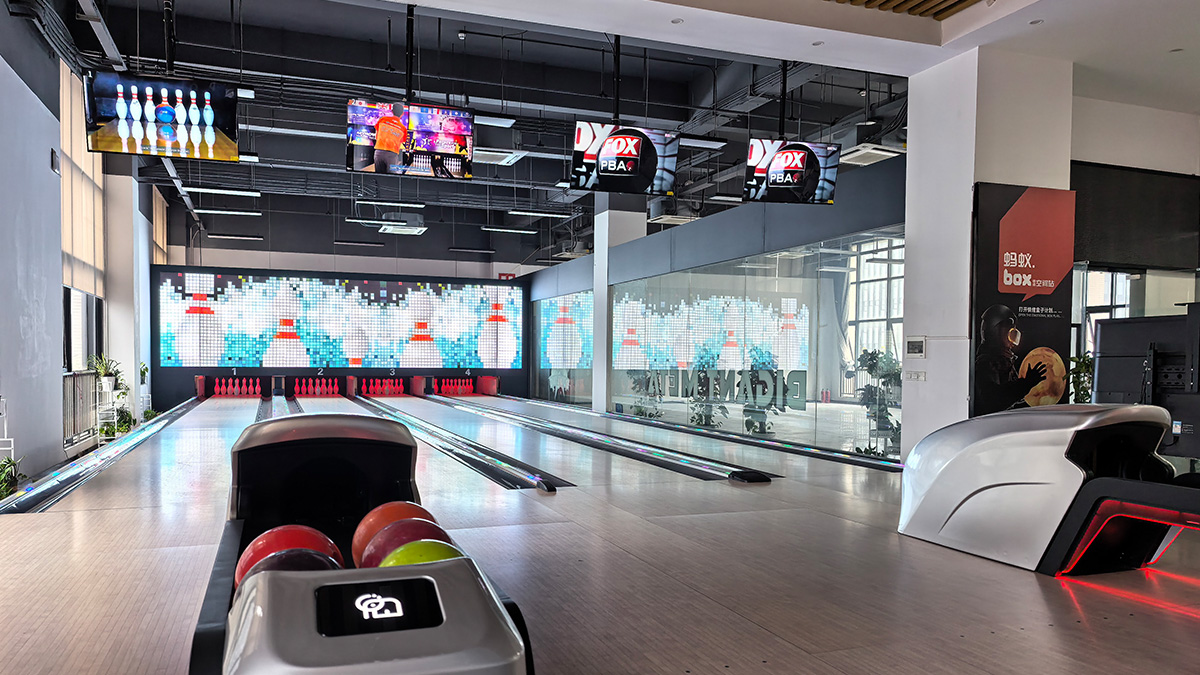 SunEye Bowling showroom — equipment display and project consultation for bowling centre developments.
Have Questions or Need More Details?
Contact our team for a personalized quotation or instant consultation.
Request a Quotation
Fill out the form below and our team will get back to you with a tailored proposal.
WhatsApp Direct Chat
Prefer to chat in real-time? Message us on WhatsApp for instant assistance & quick answers.
- Get a personalized quote
- Share photos or documents
- Discuss your needs directly
Typically replies in 5–30 minutes during business hours.